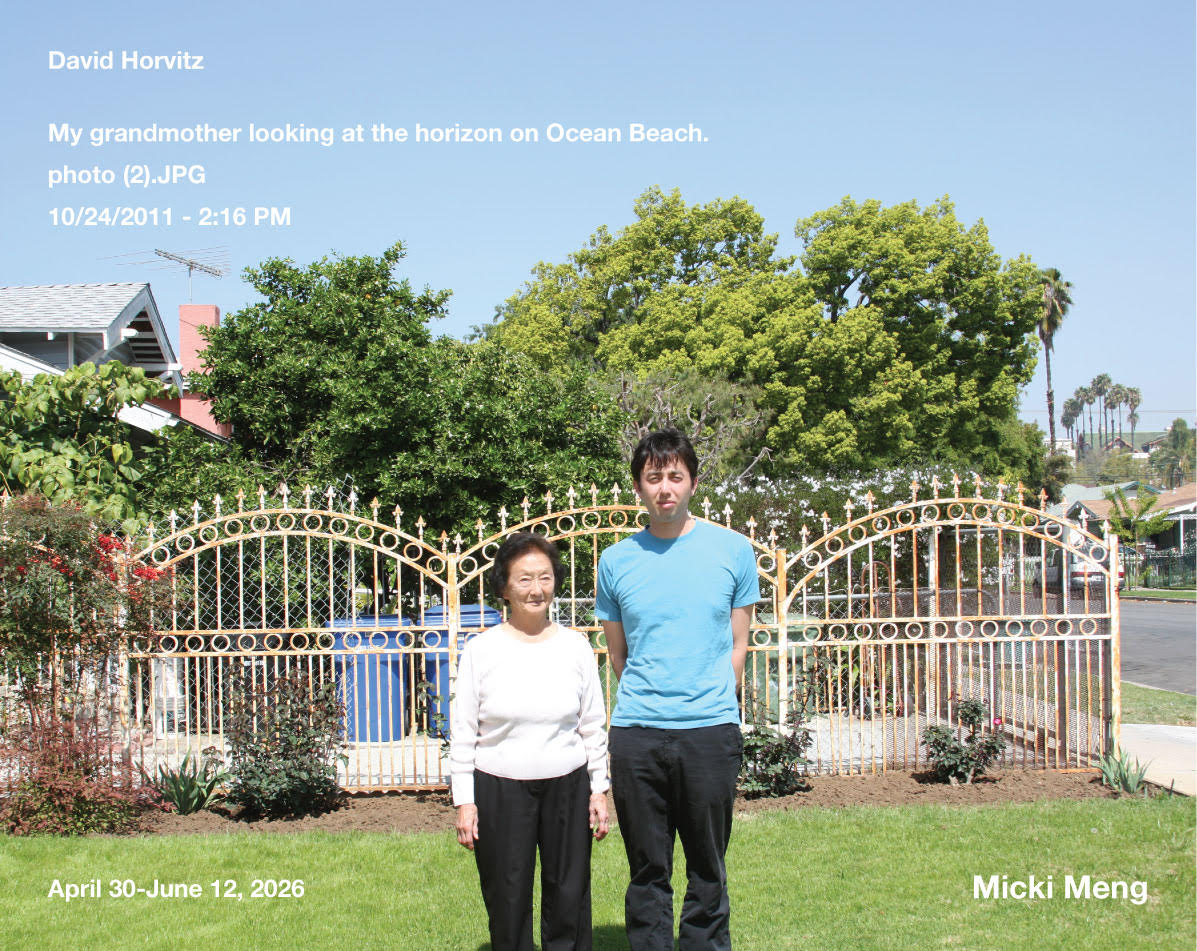
David Horvitz
My grandmother looking at the horizon on Ocean Beach" photo (2).JPG 10/24/2011 - 2:16 PM
Micki Meng
April 30–June 12, 2026
Hi David,
Hope things are good in London. As you know, I’m writing the press release for your upcoming show at Micki Meng, and I was thinking about the way your work so often pokes and prods at the assumptions, givens, customs, and expectations of the art system. Not as publicity stunts (though some of your stunts do attract publicity) nor as acts of hostility, despite the occasional cease and desist letter you might receive from said system, but really as affirmations of art’s historical task in poking and prodding authoritative systems. There is of course deep affection for art history in your work—particularly the lineage of conceptual art, to which your work frequently engages and participates in. So, in lieu of a conventional press release, and in gentle resistance to the assumed authority of the genre, I thought I’d send you a questionnaire to answer.
Yours,
Michael
- Micki told me that the show you’re doing for her gallery is about your grandmother. As it happens, I have a print of yours, which is a page from your book (nostalgia), first published by Gato Negro Ediciones in 2019, in which written captions replace .jpg photo files that have been deliberately erased. (I also saw a slideshow version of this work at ICA LA.) My print reads:
IMG 4973.JPG
My grandmother
hitting a wind chime
with a stick in one
of my performances
in Los Angeles.
8/26/2016
9:01 PM
And this morning I awoke to an image of a younger version of you standing next to grandmother on our WhatsApp group chat. What can you tell me about your grandmother, and why does she frequently appear in your work?
I don't know how to answer why. I mean, I can give you a sufficient answer. But is that a real honest reply? My grandmother's name is Kiyoko. She was born in California, grew up mostly in Sonoma County, was incarcerated in Eastern Colorado, ended up in a Buddhist temple in San Francisco after the war, then as a domestic worker, then she lived the rest of her life in Los Angeles on 6th Ave. My garden is on 7th Ave., just a block off and down the street. It's interesting my studio and garden is only a few blocks away from some of my earliest memories of the city of Los Angeles. Why does she end up in my work? She just does! When I was an undergrad I did a project where I took her to the incarceration camp in Colorado with my mom by Amtrak train, imagining we were traveling on the same train tracks. In another work, I photographed the stars from the camp—even though this view was somewhat indistinguishable from other views of the stars, I thought this view was her unique view, her unique perspective, framed within barbed wire fence, looking up at the sky. There are other works too. (I've just come back to this question to finish, but now the lobby is filled with people, it is after 7am, and they've turned the music on.)
- Micki Meng gallery is a small storefront located at 716 Sacramento St. in San Francisco’s Chinatown. What is your relationship to San Francisco or the Bay Area?
This is connected to the previous question. Because my grandmother grew up in Sonoma, we had many relatives in and around San Francisco. So I have many childhood memories of San Francisco. These memories blur into my college years at UC Riverside, when I would take spontaneous trips up North to visit friends who moved there in college. Coincidentally, one friend went to Sonoma State, so I spent many years driving around the Sonoma landscape, where my grandmother would have spent her childhood. I believe her childhood home may have even been on the land that is the university now.
- A lot of your work comes from—and sometimes directly addresses—social connection. Where or how did you meet Micki?
I believe the first time I met Micki was in Berkeley in a Japanese izakaya directly across from the Berkeley Art Museum and Pacific Film Archive. I believe I was with David Senior, Margot Norton, and Leif Hedendal.
- Are you still banned from Wikipedia?
Well, I was never unbanned. But then, was my banning permanent? That seems kind of harsh. Is there an official procedure to come back to Wikipedia? I believe If I officially started adding content again with my name, probably no one would stop me. I actually remember now that one of the Wikipedia editors who was behind the call to ban me, ended up getting banned! So to answer your question, technically I am probably still banned! But would anyone care anymore? Probably not! But you never know...
- You have a semi-public garden on 7th Street in the West Adams neighborhood of Los Angeles. What’s happening in the garden lately? How are the crows doing?
I just saw the first California poppy flower just before I left for London. I saw a few clarkia flowers as well. The sycamores have leafed. There are a lot of new shells: mostly scallop, abalone, and whelk. Though, there are also new mussel and oyster shells added. The crows are around. I sometimes see a cat in there, who always leaves when I arrive. Three racoons descended from the cypress tree some months ago. The artemesia is smelling great as usual.
- Back to (nostalgia), which takes its title from a 1971 film by Hollis Frampton, in which a voiceover describes a photograph that we will see lit on fire in the next shot. In your (nostalgia), images disappear too—and like Frampton’s film, these disappearing photos are also stand-ins for memory. It strikes me that so much of your work is about time, loss, and the elusiveness of experience. Does this assessment ring true? If so, what’s changed about your relationship to time, over time?
Your assessment is correct, about time and loss and experience. It's strange to think about time while jet-lagged. It's strange to think about anything. I've always loved jet lag, and have always considered it a kind of drug, because it is a shift in perception. It is a temporal displacement. Or maybe all displacements are temporal displacements because place is so much about time and experience. Of course working in a garden has made me aware of cyclic moments. I think seasons are too generalized. I know when spring technically starts—but the garden unravels in a series of cyclical moments. When the ceanothus blooms. When the first California poppy blossom arrives. Years before I had the garden I planted poppies in the between the alley and my studio—an area ruptured by the fence guarding the parking lot (is this parking lot a garden since a garden is something that is guarded?). These poppies always bloom weeks or even months before the poppies in the garden bloom, and they are only a ten second walk away. It's probably because of the heat of the asphalt. But I always like to think about the place of the garden and the place of the parking lot—both unique and on their own calendrical system.
Questionnaire by Michael Ned Holte.
716 Sacramento Street
San Francisco, CA
Gallery Hours:
Wed-Fri from 12-3pm
Saturdays 1-5pm
Happily by appointment
www.mickimeng.com
www.desiringmachines.org
Micki Meng dedicates a portion of its profit, time, and activity toward planetary recovery.