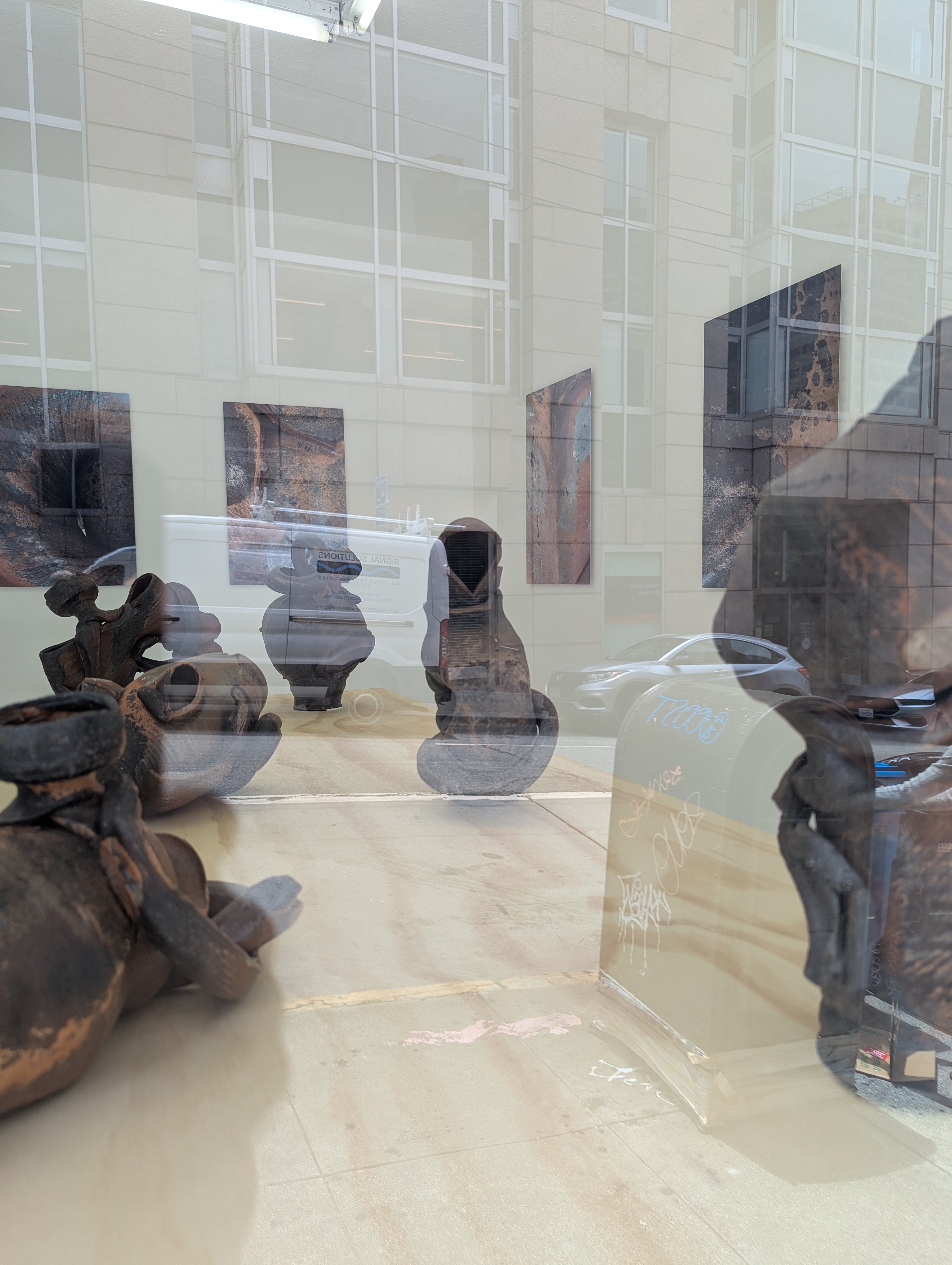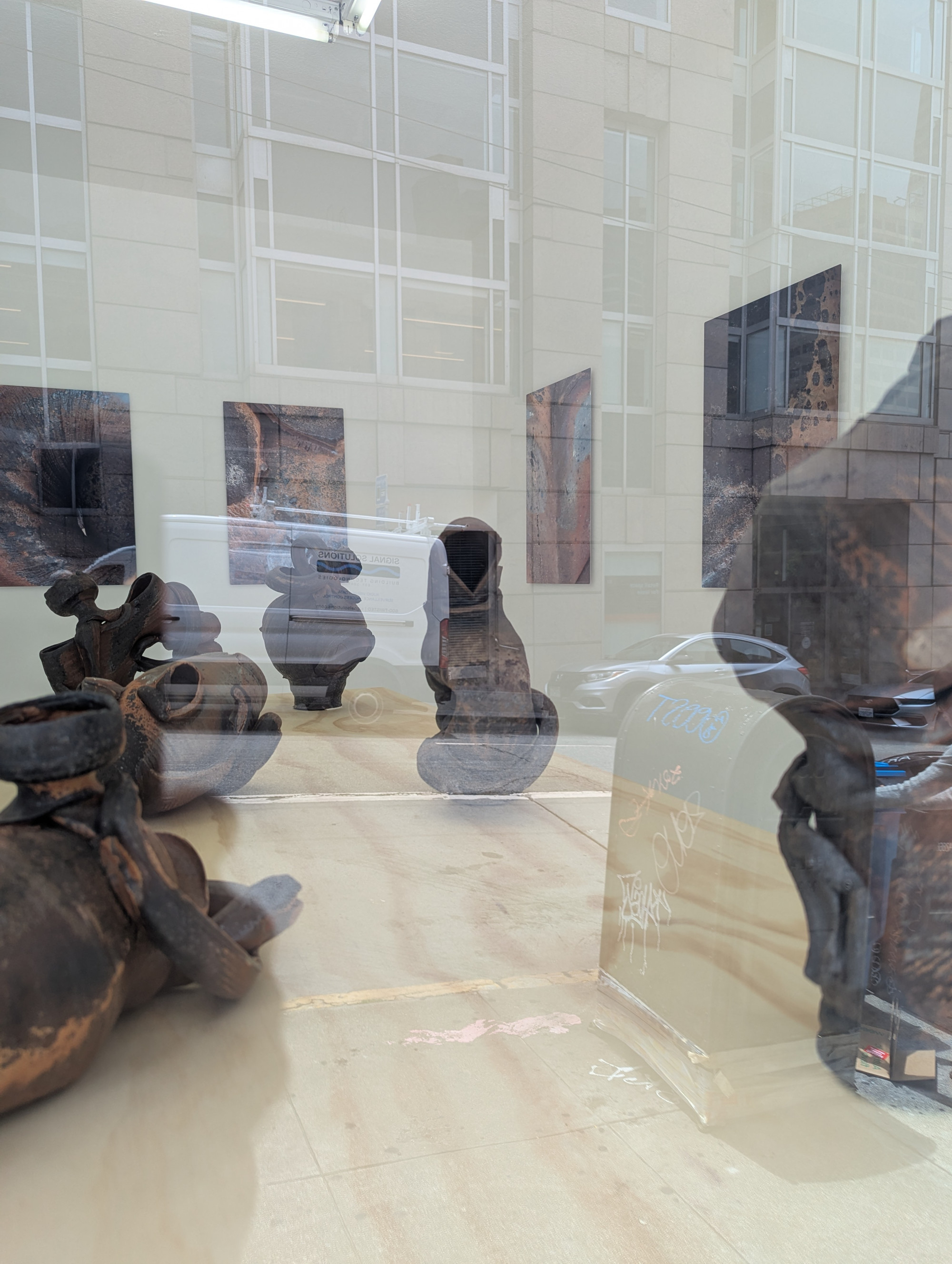
Clay finds its way. Slowly, it assumes shape, then color. Regulating heat from concentration to afterglow, choreographies of firing glister its depths. These temporal blasts leave in every incident a radius of information. Here, you meet the aftermath of its becoming: this ancient material as a living being, a relationship that muscles into action. From the warmth of thrown mud—its fire-hugging substance uniquely formulated from two northern California stoneware clays—all manner of expressions and densities emerge. Mineral interactions unloose tremendous regions impossible to know but small enough to hold—if not in mind, then in hand. Hematite crystals may barnacle the rim of a minuscule basin, contouring the impression of an infinitesimal salt lake. In the wrestling-circle of the wood-fired kiln, ferocious energies accumulate. Storms brew, pressures mount, atoms merge, ashes melt. Pouring over their destabilized, weathered, and mottled textures, it is as if this flushed earth had suffered the salted blister of the ocean’s spindrifts, or had mineralized from magma into a strange, fine-grained relic. Each ceramic is a climate. Those fires and forces, they only happen once in a singular moment that urges others along the infinite curve of space and time. Its fluid intensities, its lapsing frissons, were these not unlike the world from which it came? All this technicity of embodiment, all this terrestrial succulence, ensouled through an article of faith that is, firstly, a lump of clay.
Clay stakes an existential claim in that it knows things we do not—things ancient and primordial, shapes and materials of the world before the lamination of reason. Clay asserts, undeniably, that it is, and the simplicity of this bedrock claim is here honoured by Hideo Mabuchi in all its modestly confounding nature. This is-ness is synonymous with what the Greeks termed aletheia, which names truth as an active event, a clearing where reality is disclosed, where a pressure of life bursts forth into being. Aletheia embodies a language of urge. Think of a black iris, breaking free of its spathe. Ceramics seem to incite that physics, or phusis, of desire and emergence that ends not in possession but in being possessed—caught by the attentive gravity that holds us to its reality. These ceramics, forged and fired and activated in the doing, seem to work upon such mysteries.
“Earth is the most alive, the most spontaneous medium; you create your sculpture with your hands,” observed Simone Fattal. “Ceramics is the domain of infinite knowledge,” intoned her partner, Etel Adnan. Largely divested of fingerprints, the works’ smooth shifts in form nevertheless show a hand that is thinking through feeling, as if to say clay handles us. These almost-vessels—amorphous but apprehensible, curling and curvaceous—are human and humanizing in turn. Related but not quite serial, they bear an enticingly communal harmony like chamber pieces. Their concise and intense forms evidence a steadied art of metamorphosis—an art that attends to constant change, or rather, change’s inconstancy. Elements are thrown as fragments of affordance—spouts, handles, bottle tops—whose constituent parts are assembled into a composite form with its own material logic. Resilient yet responsive, something about the soft sensation of clay feels precise and enveloping at once. That “something” carries a realisation that is old, familiar and mineral-rich. What is it? It’s the loamy immersion of your hand in the earth, that downward reach, that plunging mystery. It’s the energy of seeking out the genuine reality of the world and the life within it; an energy that teaches us that imagination can guide us toward what’s real. Following Fattal and Adnan’s sentiments, it is about aliveness and infinity: clay offers an opportunity to both subsist deeper within the world and to handle it more fully.
Using a minimal amount of water, Mabuchi’s wood-firing of these ceramics catalyses myriad micro-reactions, delivering surfaces that teem with data. Note the dark granularity and the sporadic reddening, the glittery nuance of grit and the rusty splash of numerous browns. Note how they enhance awareness of the shifting textures about your own environment: the light and the now changing light; the silicates now glistening in the asphalt; the foamy white blossoms of leaves ruffling in heavy winds. Arriving to us dense and penumbral, these ceramics display the thick ferment of action that brought them into existence. Their facture is a cuneiform of molecular involvement that defies language. Ringlets, commas, dashes, scratches: they reveal a scripture of grazing and scarring, crystallized into what we call “surface.” The effect of this facture is something like the mind, isn’t it? Its nature as a ponderous, feverish thing, alight with the crackle of imagination and the electricity of need. Here lies that passional sensation of aliveness, coaxed from a body and a laboring process, that has cooled and found its form, that has discovered its way.
-Alex Bennett